


Where is the Rhodope Mountain?

Rhodopes Map
Butter, beans, and fireside feasts in Bulgaria’s green mountains
The Rhodopes are all soft slopes and stone roofs, a place where dinner is slow, and the kitchen smells like butter warmed with paprika. Daily meals are built from what the mountains offer with patience: beans that keep their shape, potatoes grated by hand, cornmeal beaten glossy, pies that puff and settle as they cool. Meat is the guest of honor on feast days, especially in spring, while every other day belongs to the garden, the dairy, and the stove.
Flavor profile and pantry
Mountain cooking here is generous but gentle. Potatoes, Smilyan beans, leeks, peppers, and pumpkin carry the meal. Butter, yogurt, sirene, and fresh curd give body and tang. Cornmeal is used as kachamak for scooping and soaking. The spice rack is modest and confident: sweet paprika for warmth and color, black pepper and garlic for backbone, chubritsa savory and parsley for lift, and a whisper of mint in bean pots. Clay pots and cast-iron pans do the slow work while a clay griddle, the sach, turns out breakfast and snacks.
Signature dishes and specialties
Patatnik
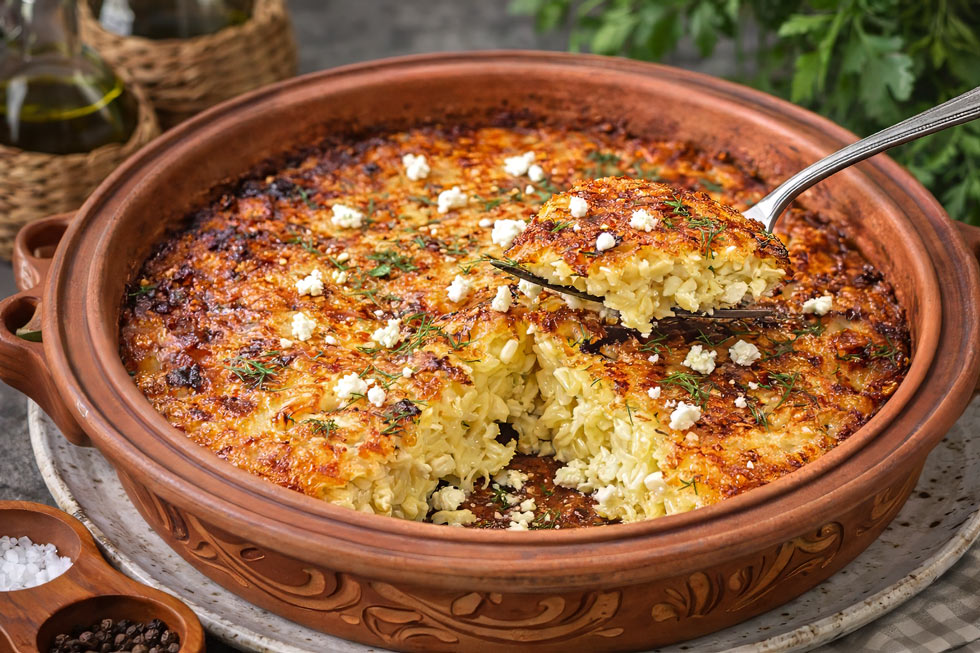
Shredded potatoes, onions, and either spearmint or savory are pressed into a wide pan and cooked over low heat until the bottom turns caramel-golden and the inside stays tender. Slice it like a pie, listen for the crisp edge, and add a spoonful of yogurt if you want to eat exactly like a local.
Rodopski klin
A mountain cousin of banitsa, this pie bakes rice, eggs, and sirene between thin sheets. The filling is airy and custardy, the top is bronzed and flaky, and a slice is somehow both lunch and breakfast.
Kachamak
Cornmeal is whisked into boiling water or milk until it thickens and turns glossy. You finish it with melted butter and crumbled Sirene, sometimes cracklings. The first spoonful is soft and sweet, the second tastes like you have always lived here.
Katmi and Marudnitsi

Thicker than pancakes and cooked on a hot griddle, these fold around butter and paprika, drizzled with honey or jam. They are the reason mornings smell like breakfast even at noon.
Buraniya
A winter stew where beans go creamy and sauerkraut lends a clean sour line. It is the dish you imagine on a snowy evening, served in a clay bowl that stays warm in your hands.
Smilyan beans
Large, heirloom beans grown in the region are used in salads with leek and mint, slow-baked casseroles, and simple soups finished with a herbal garnish. They are a Rhodope calling card.
Chushki byurek

Roasted peppers are filled with Sirene, floured, dipped in egg, and pan-fried until the seams turn craggy and golden. They arrive hot with a little yogurt on the side and disappear quickly.
Kyopolu
Roasted eggplant and peppers are chopped to a satin spread with garlic, parsley, and a touch of vinegar. Spread it on warm bread and pretend you’re going to share. Read more about the Kyopolu.
Sharen fasul s pastarma
Speckled beans simmer with bits of mountain-dried meat that perfume the pot without making it heavy. Smoky, savory, and perfect beside kachamak.
Cheverme
For spring feasts, a whole lamb turns slowly over embers while friends argue about the seasoning and play music. The result is crisp on the outside, tender on the inside, and entirely about company.
Misirena pita
A quick cornmeal-and-yogurt bake that comes to the table cut into squares for dunking into soups and stews. It is mountain infrastructure.
Breads, dairy, and sweets
Pies are everywhere: klin, milina folded like an accordion, urdenik rich with fresh curd. Village loaves hold up to stews, and misirena pita catches every last drop. Dairy shows up as a habit rather than an ingredient list: paprika butter over kachamak, yogurt with everything that needs cooling, and sirene wherever a salty nudge is welcome. Sweets are modest and satisfying: marudnitsi with honey, pumpkin bakes in autumn, oshav compote when apples and pears have moved to the drying rack.
Seasonality and rituals
Winter leans on buraniya, beans, and sauerkraut dishes that offer warmth and thrift. Spring breaks open with St George’s Day lamb, sometimes as cheverme, and with the first bright greens. Summer starts on the grill and continues in the salad bowl. Autumn is for roasting peppers and eggplants for jars of kyopolou and for preparing the pantry for snow. The rhythm is the recipe.
Where and how to try it
In Smolyan and the villages of Shiroka Laka, ask for klin, patatnik, and bean pots cooked in clay. Around Velingrad, dairy-rich pies meet spa days and slow afternoons. By the lakes near Dospat, evenings are cool, and stews are slow. In small villages, the most interesting dishes might be off the printed menu, so ask what the kitchen is proud of today. Markets are best before noon for warm bread and bean varieties to take home.
Drinks and pairings
With patatnik, klin, and kachamak, choose fresh, fruit-led whites from the Thracian Lowlands PGI near Plovdiv and Asenovgrad, such as Muscat Ottonel or Chardonnay. With cheverme and meaty stews, pour structured reds from the Thracian Lowlands such as Mavrud and Rubin, or head west on the map and reach for Struma Valley reds from the Melnik area like Early Melnik 55 and Shiroka Melnishka Loza. For bean dishes and grilled vegetables, a dry rosé from Thracian Lowlands wineries or a light Gamza from the Danubian Plain PGI make easy lunch pairings. Begin with a small grape rakia and end with mountain herbal tea.
Order like a local
- One patatnik, please. Edin patatnik, molya. [eh-DEEN pah-TAHT-neek, MOH-lya] Един пататник, моля.
- Do you have a Klin today? Ima li klin dnes. [EE-mah lee KLEEN dness] Има ли клин днес
- Kachamak with butter and cheese, please. Kachamak’s maslo i sirene, molya. [kah-cha-MAK ss MAHS-lo ee SEE-reh-neh, MOH-lya] Качамак с масло и сирене, моля.
- Do you have spit-roasted lamb? Ima li cheverme. [EE-mah lee che-VER-meh] Има ли чеверме?
- A small glass of rakia and a tomato salad. Edna rakia i domatena salata. [ED-nah rah-KEE-ah ee doh-MAH-teh-nah sah-LAH-tah] Една ракия и доматена салата.
- The bill, please. Smetkata, molya. [SMET-kah-tah, MOH-lya] Сметката, моля.
Quick home recipe
Rodopski klin for six
Rinse 150 g rice and cook in salted water until just tender, then drain. Whisk 250 g yogurt with 3 eggs in a bowl, fold in the warm rice, 200 g crumbled Sirene, a finely sliced bunch of spring onion or leek, a pinch of savory and black pepper, and a little salt. Brush a medium pan with 70 g melted butter. Lay 3 to 4 pastry sheets, brushing lightly between layers. Spread half the filling. Add 2 more sheets, then the remaining filling, and finish with 3 to 4 sheets on top, brushing each sheet. Score the top, then bake at 180 °C for 30 to 35 minutes, until golden. Rest 10 minutes before slicing. Serve warm with a spoonful of yogurt.
Traveler’s practicality
Portions are generous, so share a clay pot dish and begin with salad. Ask early for slow items like cheverme or baked beans. Cash helps in small villages, and cards are common in towns. Mountain roads are scenic and slow, so plan dinner times with travel in mind. If jars of peppers and eggplant sit near the door, the kitchen preserves its own supplies, and you are in the right place.
Rhodopes food glossary
- Patatnik: grated potato pie typical of the Rhodopes
- Klin: rice, eggs, and cheese pie from the region
- Kachamak: cornmeal mush finished with butter and sirene
- Katmi: thick pancakes cooked on a griddle or clay sach
- Izvara: fresh curd used in pies
- Pastarma: air-dried meat used to flavor bean dishes
- Buraniya: bean and sauerkraut stew
- Cheverme: whole lamb spit-roasted for feasts
- Chubritsa: savory, the defining Bulgarian herb
- Dzhodzhen: spearmint, common in beans and lamb
Fun facts

- Smilyan beans are prized not only for their size but also for their creamy texture that remains intact after long cooking.
- Patatnik has household variations that are almost a personality test: mint or savory, thicker or thinner, pan or oven.