

Health Insurance in Bulgaria: A Public Foundation with a Private Supplement
Bulgaria’s health insurance system is built on a simple yet powerful structure: NHIF is the mandatory basic health insurance foundation, while private health insurers provide optional supplementary coverage on top of it. The distinction matters. Private insurance is not a replacement for NHIF. It is an added layer — useful, growing, and increasingly relevant for employers and households, but still small compared with the public system.
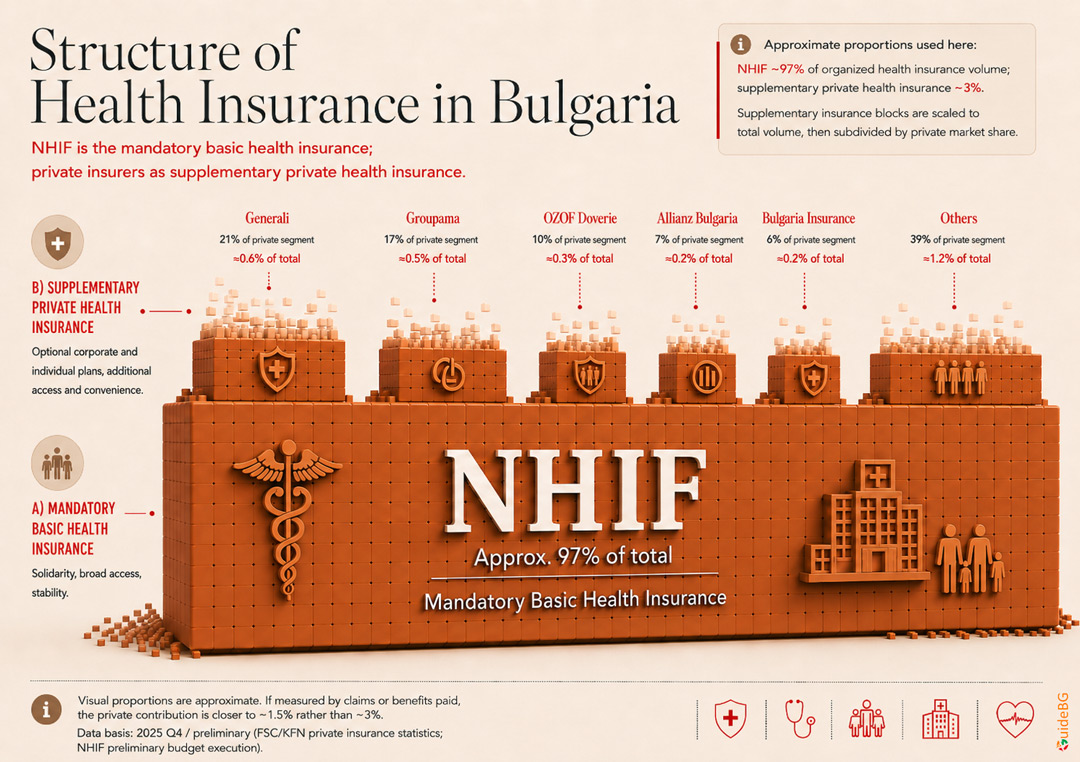
Based on 2025 Q4 preliminary data, the National Health Insurance Fund accounts for approximately 97% of organized health insurance volume, compared with supplementary private health insurance premiums. Private health insurers collectively account for about 3% of that premium volume comparison. If the comparison is based not on premiums but on claims or benefits paid, the private contribution is even smaller — closer to 1.5%. This makes the picture clear: NHIF is the large structural base; private insurance is a narrow supplementary tier built on top of it.
Within that private tier, the market is fragmented. In the current premium-based view, Generali holds about 21% of the supplementary private segment, followed by Groupama at 17%, OZOF Doverie at 10%, Allianz Bulgaria at 7%, and Bulgaria Insurance at 6%. The remaining insurers together form a substantial “Others” category of roughly 39%. This fragmentation is important: the private layer is not dominated by a single company, and many insurers participate in a relatively small total market.
The strategic conclusion is not that private health insurance is insignificant. Rather, it plays a different role. NHIF provides the mandatory public base: solidarity, broad access, and financial scale. Supplementary private insurance offers choice, speed, convenience, broader access to services, and corporate benefit design. For employers, it is often part of a benefits package. For individuals, it can offer smoother access and additional protection beyond the public baseline.
The strongest insight from the infographic is proportionality. The private market is visible and valuable, but it remains an overlay. Bulgaria’s health insurance architecture remains overwhelmingly public at its core, with private insurers serving as modular additions rather than a parallel replacement system. Understanding that scale helps policymakers, employers, insurers, and patients discuss reform with greater precision: the question is not whether private insurance replaces NHIF, but how effectively it can complement it.
Data basis: 2025 Q4 / preliminary. Private shares use FSC/KFN premium statistics; NHIF uses preliminary budget execution as of 31 December 2025.