

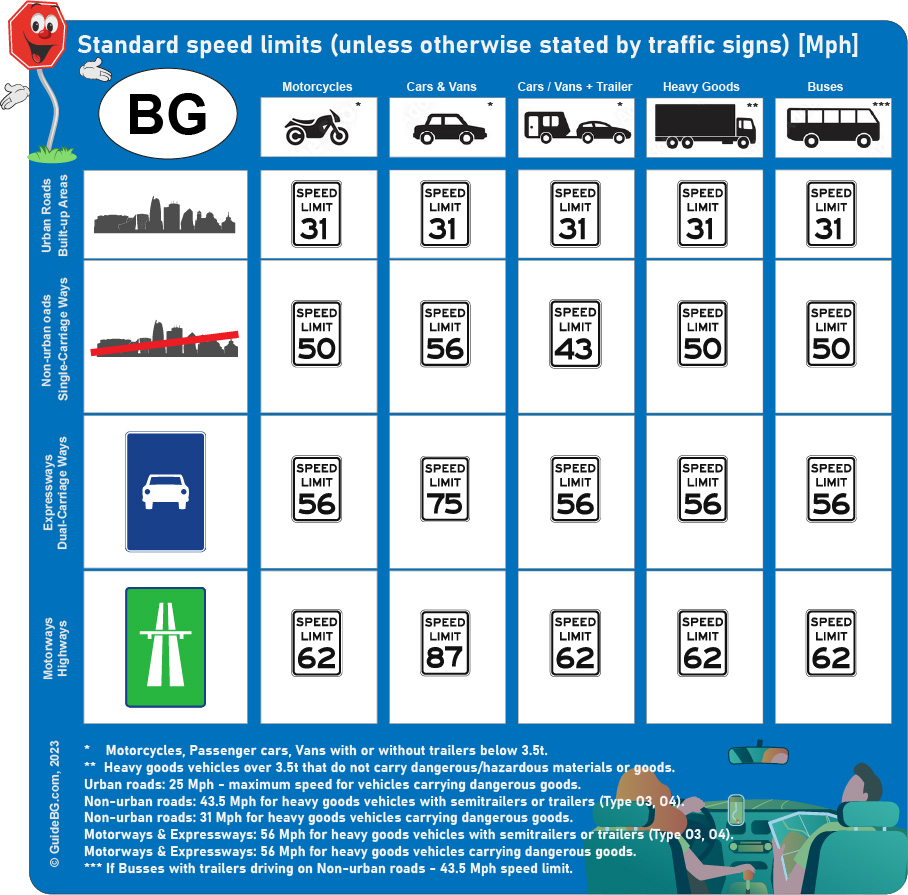
Bulgaria uses kilometers per hour, not miles per hour. All road signs, legal limits, cameras, and speeding thresholds are based on km/h.
For an ordinary Category B car, the principal limits are approximately:
- 31.1 mph in built-up areas — legally 50 km/h
- 55.9 mph outside built-up areas — legally 90 km/h
- 74.6 mph on expressways — legally 120 km/h
- 87.0 mph on motorways — legally 140 km/h
Use the mph figures only as a driving aid. The corresponding km/h value is always the legally controlling limit.
Bulgaria’s principal car speed limits in mph
| Road or area | Approximate mph | Legal limit |
|---|---|---|
| Residential zone | 12.4 mph | 20 km/h |
| Zone 30 | 18.6 mph | 30 km/h |
| Built-up area | 31.1 mph | 50 km/h |
| Ordinary road outside a built-up area | 55.9 mph | 90 km/h |
| Expressway | 74.6 mph | 120 km/h |
| Motorway | 87.0 mph | 140 km/h |
A Bulgarian “Zone 30” means 30 km/h, not 30 mph. It is approximately 18.6 mph.
Posted signs, temporary restrictions and electronic motorway signs take precedence over the default limits. Weather, visibility and road conditions may require a lower speed even when no lower sign is displayed.
Full vehicle-category table in mph
The Bulgarian Road Traffic Act sets the legal limits in km/h. The mph conversions below are approximate:
| Vehicle category | Built-up area | Outside built-up area | Motorway | Expressway |
| A, A2 motorcycles | 31.1 mph (50) | 55.9 mph (90) | 87.0 mph (140) | 74.6 mph (120) |
| A1 motorcycle | 31.1 mph (50) | 49.7 mph (80) | Prohibited | Prohibited |
| B car or light vehicle | 31.1 mph (50) | 55.9 mph (90) | 87.0 mph (140) | 74.6 mph (120) |
| B1 | 31.1 mph (50) | 43.5 mph (70) | Prohibited | Prohibited |
| BE, C1, C1E, D, D1, D1E, DE | 31.1 mph (50) | 49.7 mph (80) | 62.1 mph (100) | 62.1 mph (100) |
| C, CE | 31.1 mph (50) | 49.7 mph (80) | 55.9 mph (90) | 55.9 mph (90) |
| Tkt, wheeled tractor | 31.1 mph (50) | 31.1 mph (50) | Prohibited | Prohibited |
| Ttm, tram | 31.1 mph (50) | — | — | — |
| AM, moped | 28.0 mph (45) | 28.0 mph (45) | Prohibited | Prohibited |
| Self-propelled machinery | 24.9 mph (40) | 24.9 mph (40) | Prohibited | Prohibited |
Numbers in parentheses are the legal km/h limits.
Vehicles transporting dangerous goods are limited to approximately 24.9 mph in built-up areas, 31.1 mph outside built-up areas and 55.9 mph on motorways and expressways. The controlling limits are respectively 40, 50 and 90 km/h.
Speeding fines in Bulgaria
Fines are determined by how many kilometers per hour the corrected enforcement speed exceeds the applicable limit. An mph conversion cannot change the legal band.
Bulgaria adopted the euro on 1 January 2026. The statutory BGN amounts are converted at the fixed rate of €1 = BGN 1.95583 under the Euro Introduction Act.
Ordinary drivers
| Legal excess | Approximate mph excess | Built-up area | Outside built-up area |
| Up to 10 km/h | Up to 6.2 mph | €10.23 (BGN 20) | €10.23 (BGN 20) |
| 11–20 km/h | 6.8–12.4 mph | €25.56 (BGN 50) | €25.56 (BGN 50) |
| 21–30 km/h | 13.0–18.6 mph | €51.13 (BGN 100) | €51.13 (BGN 100) |
| 31–40 km/h | 19.3–24.9 mph | €204.52 (BGN 400) | €153.39 (BGN 300) |
| 41–50 km/h | 25.5–31.1 mph | €306.78 (BGN 600), two-month ban and 18 points | €204.52 (BGN 400) |
| More than 50 km/h | More than 31.1 mph | €357.90 (BGN 700), three-month ban and 18 points | €306.78 (BGN 600), two-month ban and 18 points |
For more than 50 km/h over the limit, add €25.56 for every further complete 5 km/h of excess. That additional increment is based on BGN 50.
Short-term visitors are not normally subject to Bulgarian control-point deductions on a foreign license, but fines and any driving ban in Bulgaria still apply; foreign license holders normally resident in Bulgaria may also be required to exchange their license after a point-bearing offense.
The mph bands are deliberately shown as decimals. Rounding them into whole-number mph ranges could place a driver in the wrong legal bracket.
Public-passenger and dangerous-goods vehicles
| Legal excess | Approximate mph excess | Fine and consequence |
| Up to 10 km/h | Up to 6.2 mph | €10.23 (BGN 20) |
| 11–20 km/h | 6.8–12.4 mph | €25.56 (BGN 50) |
| 21–30 km/h | 13.0–18.6 mph | €76.69 (BGN 150) |
| 31–40 km/h | 19.3–24.9 mph | €255.65 (BGN 500) |
| 41–50 km/h | 25.5–31.1 mph | €409.03 (BGN 800) |
| More than 50 km/h | More than 31.1 mph | €511.29 (BGN 1,000), three-month ban and 18 points |
Above 50 km/h over the limit, add €25.56 for each additional full 5 km/h.
Control points changed in 2026
The speed-related control-point schedule changed in May 2026. Lower speeding bands no longer carry the former 2, 6 or 12-point deductions.
The current ordinance provides:
- 18 points for more than 40 km/h over the limit in a built-up area;
- 18 points for more than 50 km/h over the limit outside a built-up area;
- 18 points for more than 50 km/h over the limit in a public-passenger or dangerous-goods vehicle;
- 21 points for a qualifying repeat serious offense;
- 26 points for a qualifying systematic serious offense.
The same rules apply to average-speed offenses.
These are Bulgarian control points. They should not be described as automatically transferring to every visitor’s home-country license. A Bulgarian driving ban is a separate legal consequence.
Repeat and systematic serious speeding
The double and triple fine rules do not apply to every repeated minor speed offense. They apply to the serious thresholds listed above.
| Offence status | Fine | Driving ban | Points |
| First qualifying serious offense | Base fine | Two or three months | 18 |
| Repeat qualifying offense | Double fine | Three months | 21 |
| Systematic qualifying offense | Triple fine | Six months | 26 |
“Repeat” generally means the same type of offense within one year after the earlier sanction became final. “Systematic” means three or more same-type offenses within the statutory one-year period.
Serious cases may also result in temporary retention of the license or temporary removal of the vehicle from use while the proceedings are resolved.
Average-speed enforcement
Bulgaria has enforced average speed on certified road sections since 7 September 2025.
Cameras record the vehicle at the beginning and end of a controlled section. The system calculates the average speed from the distance and travel time.
Average-speed violations receive the same fine, driving ban, and points as an equivalent instantaneous-speed offense. Enforcement remains based on km/h, even if the vehicle’s dashboard displays mph.
Because new sections may be certified, consult the current BG Toll section list instead of relying on an old count.
Camera tolerance and corrected speed
There is no statutory “free” amount above the speed limit.
MVR guidance explains that the measurement error commonly applied in the driver’s favor is:
- 3 km/h at measured speeds up to 100 km/h;
- 3% at measured speeds above 100 km/h.
This is a technical correction, not permission to speed. The corrected or punishable speed shown on the official notice controls the penalty.
Other forms of enforcement
Speeding may be recorded through:
- Fixed cameras
- Mobile camera systems
- Police vehicles
- Section-average-speed cameras
- Approved municipal systems connected to MVR
Municipalities have been able to operate approved automated systems and transfer data to MVR since 7 May 2026. MVR handles the administrative penalty process.
Police can also conduct enforcement from unmarked official vehicles, subject to the statutory rules for police identification and stop signals.
Using an active device that interferes with speed-measuring equipment carries a separate €51.13 fine, converted from BGN 100.
Paying a speeding fine
Do not pay cash to a police officer at the roadside. An official card payment may be available through a mobile POS terminal in an appropriately equipped police car.
Other payment options listed by MVR include:
- The MVR electronic-services portal
- The account printed on the penalty document
- Bank or internet banking
- POS terminals at MVR offices
- Postal and licensed payment services
Pay each fine separately and copy the document series, number, and liable person’s details exactly.
Early-payment discounts
| Penalty document | Reduced-payment rule |
| Electronic speed fiche | Pay 70% within 14 days of receipt |
| Ordinary paper fiche | Pay 80% within seven days of imposition |
| Penalty decree | Pay 80% within 14 days of service if the fine portion will not be appealed |
A reduced payment affects the monetary fine. It does not automatically remove control points or a driving ban.
An electronic fiche that is appealed and upheld by the court becomes payable in full.
Nominating the driver or appealing
Within 14 days of receiving an electronic fiche, the owner or registered user may identify the actual driver by submitting the required declaration and a copy of that person’s driving license.
For an electronic fiche:
- A written objection to the relevant MVR director may be made within seven days on the statutory cancellation grounds.
- A court appeal may be filed within 14 days of receipt.
- If an objection was made first, the court-appeal period runs for 14 days from notification that cancellation was refused.
Electronic fiches may be appealed regardless of the monetary amount.
For a rental vehicle, the rental company may identify the renter or driver. A contractual administration charge from the rental company is separate from the Bulgarian fine.
Tips for drivers whose speedometer shows mph
- Switch the dashboard or navigation display to km/h if possible.
- Remember that 30 on a Bulgarian Zone 30 sign means about 18.6 mph.
- Use 31.1 mph only as a conversion of the legal 50 km/h urban limit.
- Do not round 74.6 mph up when the legal expressway limit is 120 km/h.
- Check every posted restriction rather than relying only on the default road type.
- Expect average-speed control as well as individual cameras.
- Use the km/h speed stated on a penalty notice when identifying the fine band.
For the complete metric version, see Speed Limits and Speeding Fines in Bulgaria in km/h. You can also check an individual case with the GuideBG Road Fines Calculator and Driver Helper.
This article provides general information and is not individual legal advice. Bulgarian km/h limits, the current legislation, and the official penalty document take precedence over any approximate mph conversion.