

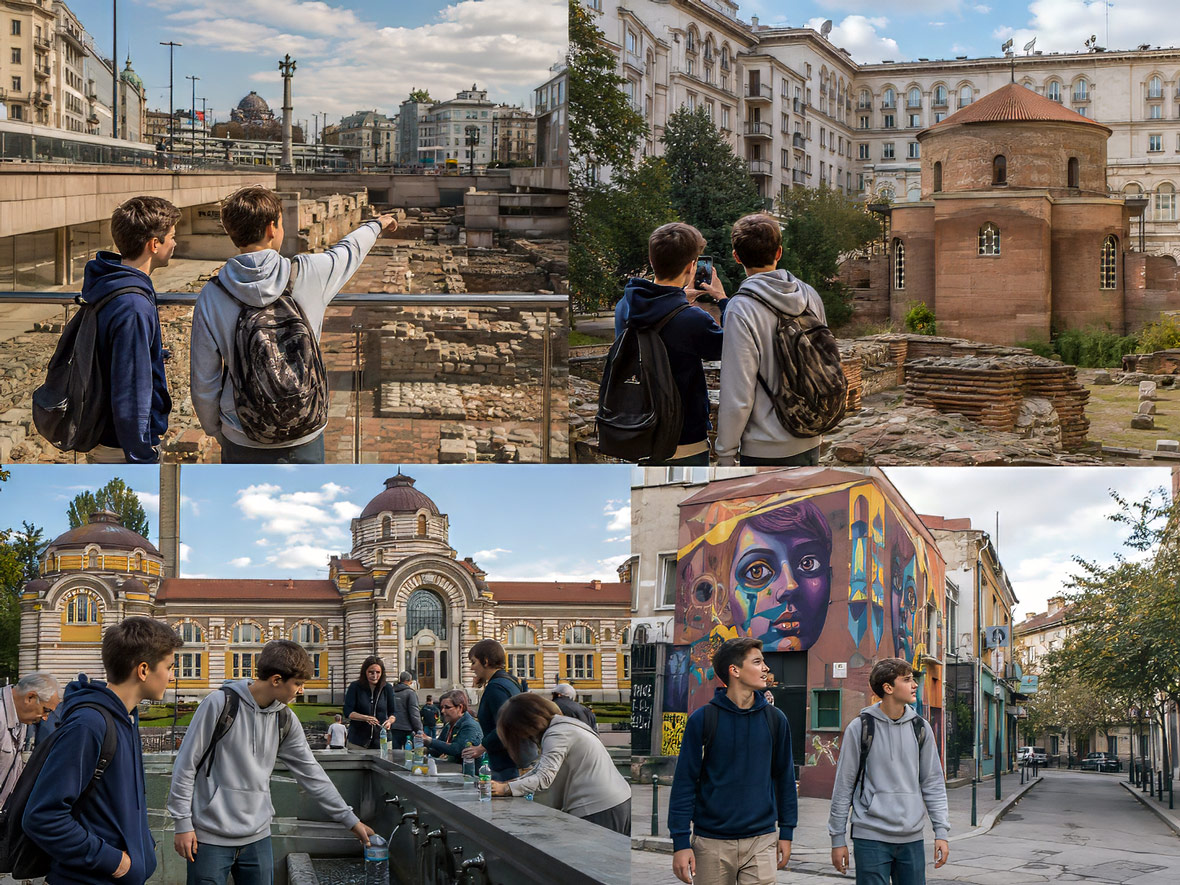
A 3–4 hour urban mission through Roman ruins, secret courtyards, mineral springs, street art and Cold War memories
Sofia is not the kind of city that reveals itself all at once. For teenagers, that is exactly what makes it exciting.
At first glance, Bulgaria’s capital can look like a mix of traffic, old apartment blocks, government buildings, churches and busy shopping streets. But look closer and Sofia becomes something much more interesting: a city built in layers. Roman streets hide beneath the metro. A 4th-century brick church sits quietly inside a courtyard surrounded by modern buildings. Hot mineral water flows from public fountains. Street art covers walls in backstreets. And inside an ordinary apartment, the Cold War suddenly feels close enough to touch.
For two 14-year-old boys, especially boys growing up in Switzerland, Sofia should not be presented as a classic sightseeing walk. It should feel like a mission.
Welcome to Operation Serdica.
The goal is simple: prove that Sofia is not one city, but several cities stacked on top of each other — Roman, medieval, Ottoman, communist and modern.
The Concept: Turn the City into a Game
Instead of saying, “Now we are going to see some monuments,” give the teenagers a mission.
Their task is to collect evidence that Sofia is a city of hidden layers. One boy can be the Navigator, responsible for the map and route. The other can be the Evidence Collector, responsible for photos, videos, and details that adults might miss.
The adult or guide becomes the Handler: the person who gives clues, not lectures.
The route works best in 3.5 to 4 hours and mostly stays within central Sofia. It combines walking, discovery, challenges and one strong final experience.
Level 1: The City Under the City
Start at Serdika Metro Station and the Ancient Serdica archaeological zone.
This is the perfect opening scene. In many European capitals, history stands above ground in the form of castles, cathedrals, or old-town squares. In Sofia, history often appears under your feet.
The Ancient Serdica complex includes the Largo zone beneath Nezavisimost Square, where visitors can see the remains of the Roman city, including part of the decumanus maximus, one of the main streets connecting the eastern and western gates of ancient Serdica. The wider archaeological complex also includes streets, residential buildings, early Christian basilicas, baths, and everyday objects from the Roman city.
For teenagers, do not begin with dates. Begin with a challenge:
Mission task: Find the place where modern Sofia and Roman Sofia touch each other.
Ask them to look for:
- Roman street stones
- old brick walls below the modern street level
- glass, concrete or metro structures built around ancient ruins
- signs that people once lived, traded and moved here nearly 2,000 years ago
This first stop immediately changes the mood. Sofia is no longer just a city; it is a game map with a hidden underground level.
Level 2: The Hidden HQ
From Serdika, walk to the Rotunda of St George.
This is one of Sofia’s best “secret level” moments. You pass through a very official-looking part of the city, surrounded by the Presidency, hotels and large buildings — and suddenly, in the middle of an enclosed courtyard, there it is: a small red-brick rotunda surrounded by archaeological remains.
The St George Rotunda is widely presented by Sofia’s official tourism information as the most ancient preserved Roman building in the city and part of an ancient complex from the time of Constantine I.
For 14-year-olds, the magic is not only that the building is old. It is that it feels hidden in plain sight.
Mission task: Find the building that “should not be here.”
Let them discover the rotunda before explaining too much. Then ask:
Would this be possible in Switzerland — a tiny ancient Roman church hidden inside a government courtyard?
That comparison makes the place more memorable.
Level 3: Sofia’s Natural Power Source
Next, walk to the Central Mineral Baths and the nearby public mineral water fountains. Explain the Square of Tolerance.
This stop is perfect because it feels local, strange, and completely real. The building itself is beautiful, with yellow-and-white decoration, domes and details that make it stand out from the grey city around it. But the best part for teenagers is outside: people filling bottles with warm mineral water from public taps.
The history of Sofia’s Central Mineral Baths is closely connected to the city’s mineral springs. The smaller bath opened in 1908, while the larger bath complex opened in 1913; the building later became home to Sofia’s Regional History Museum.
This is not a museum moment. It is a street ritual.
Mission task: Test Sofia’s “thermal energy source.”
Bring a small empty bottle. Let the boys touch the water carefully first — it can be hot — and then take a small sip if they want to. The taste may surprise them.
Ask them:
Would people in Zurich, Geneva or Lausanne line up in the street to fill bottles with hot mineral water?
The answer is the point. This is one of those small Sofia experiences that feels ordinary to locals and unforgettable to visitors.
Level 4: The Modern Code – Sofia Street Art
After ancient ruins and mineral springs, change the rhythm. Head into central backstreets and the creative area around Sofia’s urban art scene.
This part should feel less like sightseeing and more like a hunt. Sofia has an official Street Art Map featuring 20 locations and works by 16 artists, and the city’s graffiti and mural scene has become one of the most interesting ways to explore its less polished corners.
Teenagers usually respond well to this because they are allowed to have opinions. Not every wall has to be “beautiful.” Some pieces may look impressive, some strange, some messy, some brilliant.
Mission task: Build a street-art evidence file.
Ask them to photograph:
- one mural they would post online
- one detail most adults would walk past
- one piece they think is art
- one piece they think is just vandalism
- one wall that feels very different from Switzerland
This creates conversation without forcing it. The boys become critics, not passive tourists.
Bonus Level: The Bulgarian Snack Challenge
Somewhere between the mineral baths and the street-art walk, add a quick food stop.
This does not need to be fancy. In fact, it should not be. The goal is to make them interact with the city like locals, even for five minutes.
Give them a few Bulgarian words to decode:
вода — water
айрян — ayran
баничка — banitsa
шоколад — chocolate
Then ask them to buy something simple using only pointing, reading Cyrillic, or trying one Bulgarian word.
For teenagers, this small moment can be more memorable than a long history lesson. It gives them a sense of independence in a place that feels unfamiliar.
Final Boss: The Red Flat
The strongest ending for this route is The Red Flat.
This is not a traditional museum. It is an interactive apartment that recreates everyday life in communist Bulgaria during the 1980s. Visitors enter the home of an ordinary family and explore rooms filled with period objects: kitchen appliances, furniture, school items, radios, clothes, toys, and domestic details from life during the Cold War. The official Red Flat description calls it an interactive experience and a “time machine” back to the final stage of Bulgaria’s communist regime.
For Swiss teenagers, this is where the tour becomes personal.
Before entering, ask them:
Imagine you have no smartphone, no Spotify, no YouTube, no cheap flights, no easy travel abroad, and very limited access to Western products. What do you do after school?
Inside, give them one last task.
Final mission: Find three objects that would be funny, useless, confusing, or impossible to understand for a teenager today.
The Red Flat works especially well because it is tactile and immersive. According to the official site, the visit usually takes about 1.5 hours and includes an audio guide in several languages, including English.
This is the emotional finish of the route. The boys start with Roman Sofia beneath the streets and end up in the everyday life of the 1980s. In less than four hours, they have moved through almost two millennia.
Suggested 3-4 Hour Route
Start: Serdika Metro / Statue of Sofia
Finish: The Red Flat or nearby Vitosha Boulevard
0:00–0:35 — Ancient Serdica ruins
0:35–0:55 — St George Rotunda
0:55–1:25 — Central Mineral Baths and hot mineral fountains
1:25–1:40 — Bulgarian snack or Cyrillic challenge
1:40–2:20 — Street-art hunt in central backstreets
2:20–2:35 — Walk toward The Red Flat
2:35–4:00 — The Red Flat experience
If the boys prefer competition and puzzles over history, replace The Red Flat with a central escape room. If the weather is bad, the Museum of Illusions Sofia is another easy indoor alternative; its official site lists it at 16 Knyaginya Maria Luiza Blvd. and gives daily opening hours from 10:00 to 20:00, with last entrance at 19:00.
Mission Card for the Boys
Give them this list at the beginning and let them collect points.
+10 points — Find a Roman street
+10 points — Find the hidden rotunda
+10 points — Touch Sofia’s hot mineral water
+10 points — Decode one Cyrillic word
+10 points — Photograph the best street-art detail
+20 points — Find something that would never happen in Switzerland
+30 points — Complete the final boss at The Red Flat
Prize idea: the winner chooses the dessert, snack, or next stop.
Why This Route Works for 14-Year-Old Boys
This tour works because it avoids the biggest mistake adults make with teenagers: turning travel into a classroom.
There are no long lectures. No endless list of monuments. No pressure to admire everything.
Instead, the city becomes a puzzle.
The boys move through underground ruins, secret courtyards, public fountains, graffiti walls and a communist-era apartment. They compare Sofia with Switzerland. They take photos. They decode signs. They decide what is cool, strange, ugly or surprising.
Most importantly, they feel like they are discovering the city themselves.
That is what makes Sofia special. Its best stories are not always polished or obvious. They are hidden behind buildings, below streets, inside courtyards and in the habits of local people.
For teenagers, that is far more powerful than a postcard view.
Practical Tips for Parents or Guides
Keep the pace quick and flexible. Teenagers do not need every detail; they need the right questions at the right moment.
Start with energy, not explanation. Use words like “mission,” “evidence,” “hidden level,” “final boss” and “urban glitch.” Let them take photos and judge what they see.
Bring water, comfortable shoes and a small empty bottle for the mineral fountains. Check the opening hours of indoor stops before the visit, especially The Red Flat, escape rooms and museums. For the best experience, book The Red Flat in advance and keep the earlier walking route compact.
Avoid turning the tour into a standard checklist of Sofia landmarks. Alexander Nevsky Cathedral, the National Theatre and Vitosha Boulevard are worth seeing, but for this particular age group, the hidden route is more memorable.
The best version of Sofia for 14-year-old boys is not the polished city. It is the layered city: ancient, strange, colorful, imperfect, and full of surprises.
That is the Sofia they will remember.