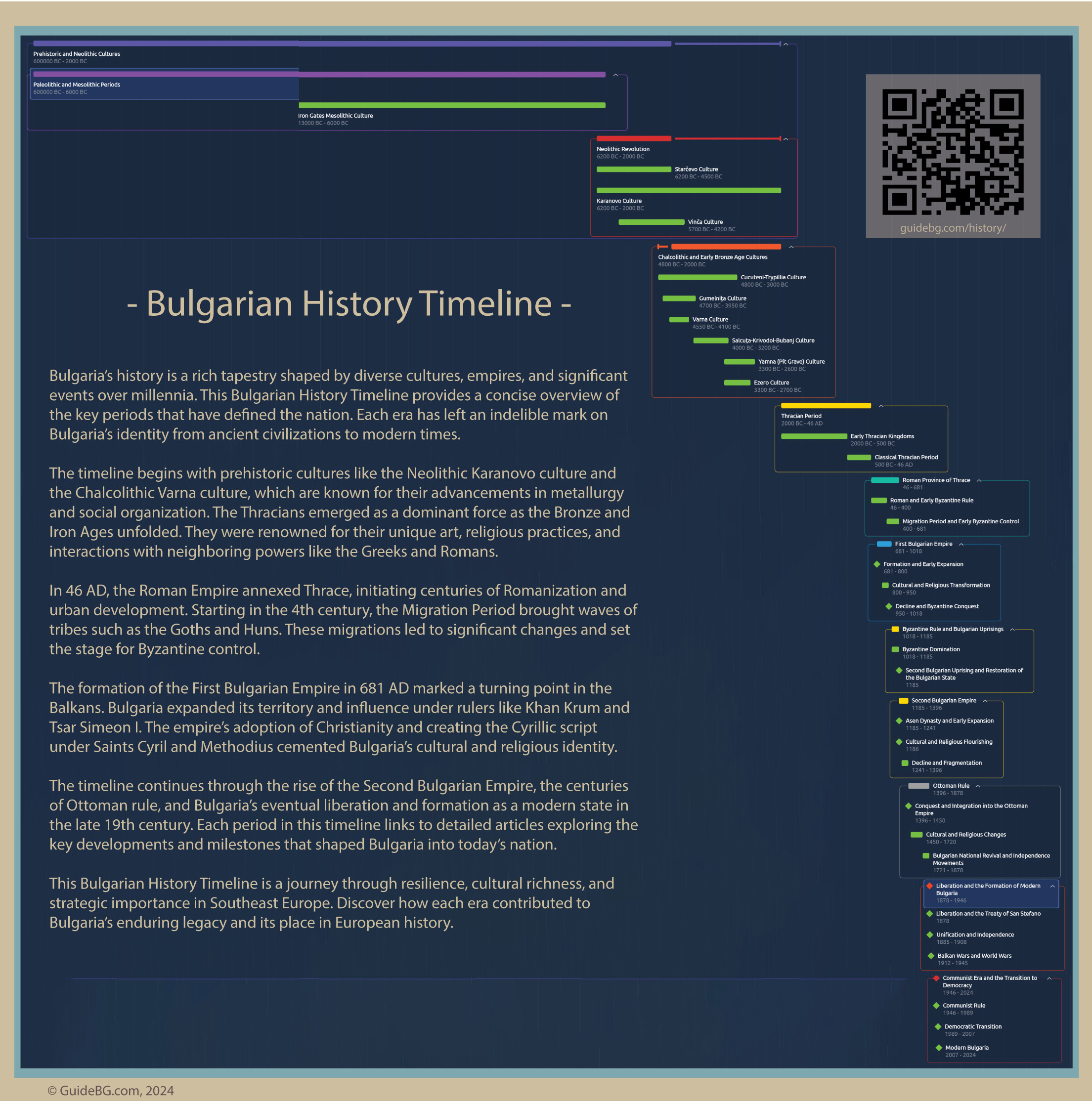

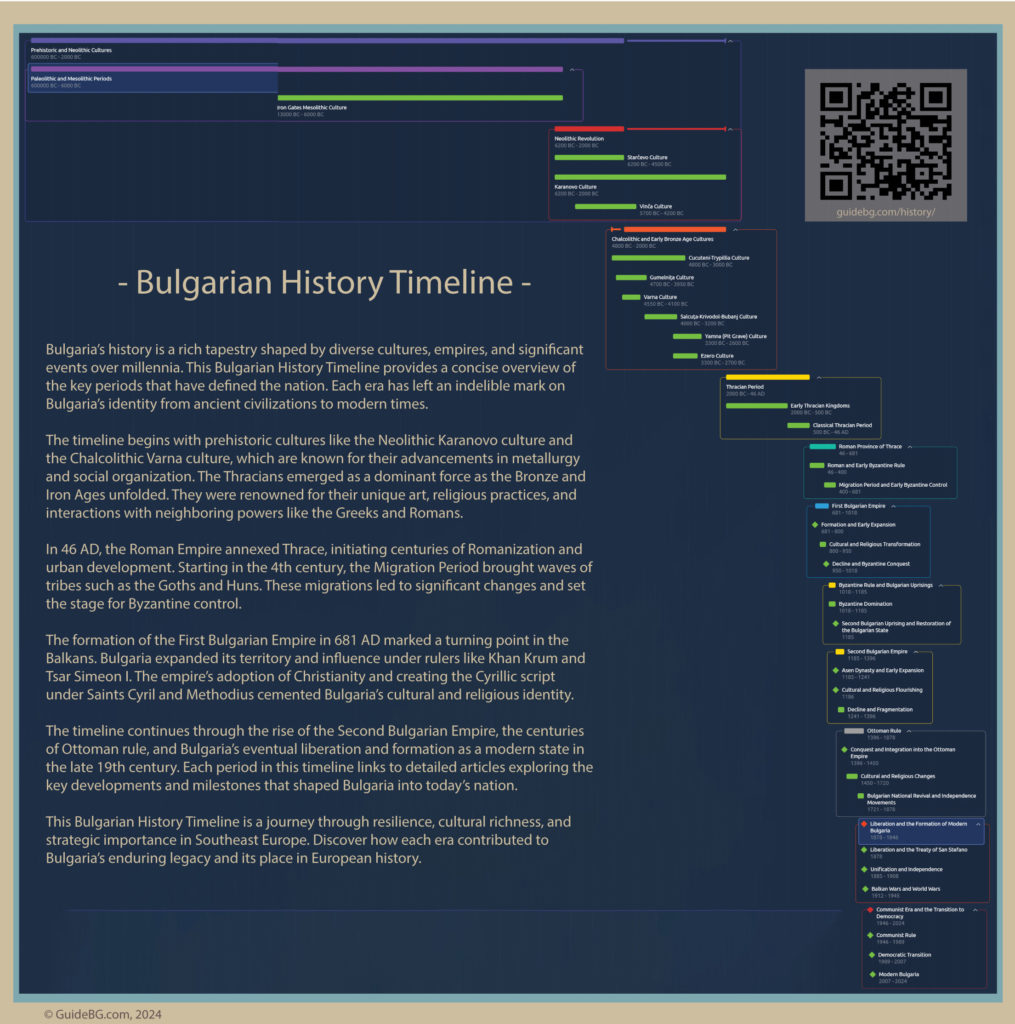
Bulgaria’s history is a rich tapestry shaped by diverse cultures, empires, and significant events over millennia. This Bulgarian History Timeline provides a concise overview of the key periods that have defined the nation. Each era has left an indelible mark on Bulgaria’s identity, from ancient civilizations to modern times.
The timeline begins with prehistoric cultures such as the Neolithic Karanovo culture and the Chalcolithic Varna culture, which are known for their advances in metallurgy and social organization. The Thracians emerged as a dominant force during the Bronze and Iron Ages. They were renowned for their distinctive art, religious practices, and interactions with neighboring powers, including the Greeks and Romans.
In 46 AD, the Roman Empire annexed Thrace, initiating centuries of Romanization and urban development. Beginning in the 4th century, the Migration Period saw waves of tribes, including the Goths and Huns. These migrations led to significant changes and set the stage for Byzantine control.
The formation of the First Bulgarian Empire in 681 AD marked a turning point in the Balkans. Bulgaria expanded its territory and influence under rulers like Khan Krum and Tsar Simeon I. The empire’s adoption of Christianity and the spread of Slavic literacy through the work of Saints Cyril and Methodius (creators of the Glagolitic script), followed by the development of the Early Cyrillic script in Bulgaria by their disciples, is commonly associated with the Preslav Literary School.
The timeline continues through the rise of the Second Bulgarian Empire, the centuries of Ottoman rule, and Bulgaria’s eventual liberation and formation as a modern state in the late 19th century. Each period in this timeline links to detailed articles exploring the key developments and milestones that shaped Bulgaria into today’s nation.
This Bulgarian History Timeline is a journey through resilience, cultural richness, and strategic importance in Southeast Europe. Discover how each era contributed to Bulgaria’s enduring legacy and its place in European history.
Prehistoric and Neolithic Cultures (c. 600,000 BCE – 4500 BCE)
Paleolithic and Mesolithic Periods (c. 600,000 BCE – 6000 BCE)
- Bacho Kiro Cave and Kozarnika Cave: Early evidence of hominid habitation, with artifacts dating back to the Lower Paleolithic.
- Iron Gates Danube Gorges Mesolithic (contextual reference) (c. 10,000–6000 BCE): Development of early hunter-gatherer communities along the Danube River, characterized by microlithic tools.
Neolithic Revolution (c. 6200 BCE – 5300 BCE)
- Karanovo sequence (I – VI) / Karanovo Neolithic–Chalcolithic phases (c. 6200 BCE – 4250 BCE): One of the most significant Neolithic cultures in the Balkans, marked by advanced agriculture, pottery, and settlement structures.
- Starčevo–Körös–Criș complex (c. 6200 BCE – 5500 BCE): Early farming communities spread across the Balkans, introducing agriculture and domesticated animals.
- Vinča culture / Vinča complex (c. 4550 BCE – 4100 BCE): This culture is known for its proto-urban settlements and a symbolic writing system that influenced later regional cultures.
Chalcolithic and Early Bronze Age Cultures (c. 4500 BCE – 2000 BCE)
Varna “Culture” / Varna Phenomenon (c. 4600 BCE – 4350 BCE; Varna I cemetery anchor: 4596 BCE – 4341 BCE):
Development of the first known gold treasure in the world, sophisticated burial practices, and social stratification.
Kodžadermen–Gumelnița–Karanovo VI (KGK VI) complex (ends around c. 4250 BCE; spans much of the 5th millennium BCE)
Gumelnița Culture (c. 4700 BCE – 3950 BCE):
Gumelnița is often used as the Romanian-facing label for the same correlated complex.
Cucuteni-Trypillia Culture (c. 4800 BCE – 3000 BCE):
A regional cultural horizon north of present-day Bulgaria: massive settlements, advanced pottery, and proto-urban developments in the northeastern Balkans.
Bubanj–Salcuța–Krivodol (BSK) Complex (Final Copper Age/transition band; within c. 4250BCE – 3300 BCE):
The transition to the Early Bronze Age was marked by the development of metalworking, particularly in copper.
Ezero Culture (EBA I-III) (c. 3300 BCE – 2000 BCE):
Continuation of Chalcolithic traditions with increasing influences from the Early Bronze Age, marked by fortified settlements.
Yamna (Pit Grave) Culture (c. 3300 BCE – 2600 BCE):
Introduction of kurgan burial practices and the spread of Indo-European languages into the Balkans.
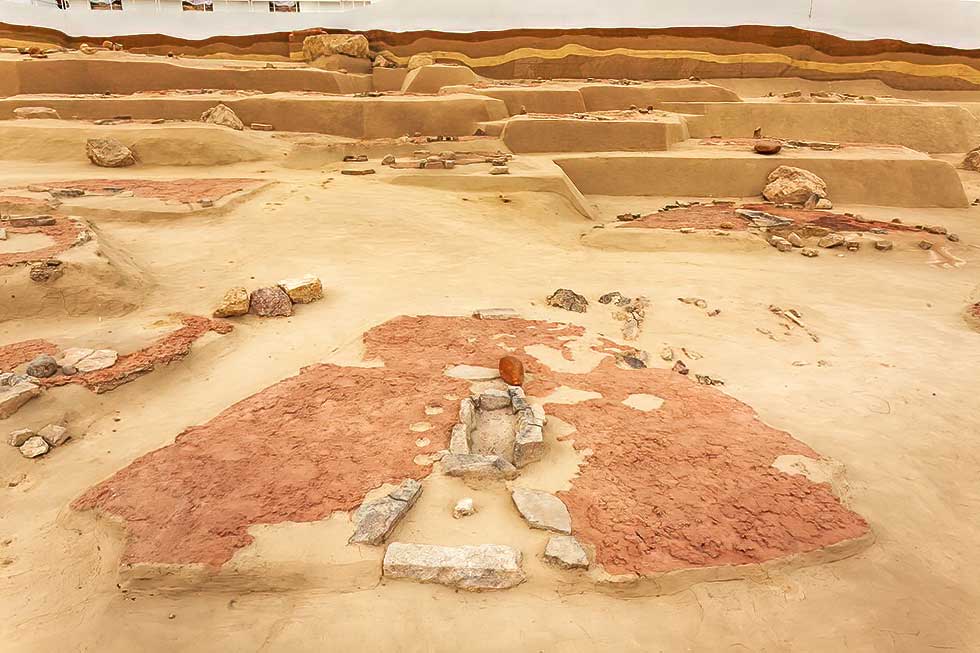
Thracian Period (2000 – 1500 BCE – 46 AD)
Formation of early Thracian tribal groupings and regional elites (Late Bronze Age to Early Iron Age).
Early Thracian Kingdoms (c. 5th century BC – early 4th century BC):
- The Odrysian Kingdom emerges in the early 5th century BC as the first large Thracian state.
- Advanced metallurgy, burial practices, and interactions with Greek colonies characterized Thracian culture.
Classical Thracian Period (5th century BC – 46 AD):
- Involvement in regional conflicts with the Persians, Greeks, and Macedonians.
- Hellenistic influence following Alexander the Great’s conquests.
- Thracian participation in Roman wars contributed to Rome’s eventual conquest of the Thracians.
Roman and Early Byzantine Rule (46 AD – 6th century AD)
- Roman Province of Thrace (46 AD – 4th century AD):
- Thrace becomes a Roman province, leading to Romanization and the establishment of major cities, including Philippopolis (Plovdiv).
- Migration Period and Early Byzantine Control (4th century AD – 6th century AD):
- Pressures from migrating tribes such as the Goths and the Huns.
- Thrace was incorporated into the Byzantine Empire with the spread of Christianity and early Byzantine administration.
First Bulgarian Empire (681 – 1018)
- Formation and Early Expansion (681 – 800 AD):
- Khan Asparuh established the First Bulgarian Empire, and expansion was under Khans Tervel, Krum, and Omurtag.
- Cultural and Religious Transformation (9th century – 10th century):
- Christianization under Boris I, the creation of the Cyrillic alphabet, and the Golden Age under Simeon I.
- Decline and Byzantine Conquest (10th century – 1018):
- Weakening due to internal and external pressures culminating in the Byzantine conquest by Basil II.
Byzantine Rule and Bulgarian Uprisings (1018 – 1185)
- Byzantine Domination (1018 – 1185):
- Integration into the Byzantine Empire and periodic uprisings like Peter Delyan’s.
- Second Bulgarian Uprising and Restoration of the Bulgarian State (1185):
- The successful revolt led by the Asen brothers established the Second Bulgarian Empire.
Second Bulgarian Empire (1185 – 1396)
- Asen Dynasty and Early Expansion (1185 – 1241):
- With the expansion under Tsar Kaloyan and Ivan Asen II, Tarnovo became a major cultural center.
- Cultural and Religious Flourishing (13th century):
- The establishment of the Tarnovo Patriarchate was a cultural renaissance in literature, art, and architecture.
- Decline and Fragmentation (1241 – 1396):
- Fragmentation due to internal strife and external pressures led to the Ottoman conquest.
Ottoman Rule (1396 – 1878)
- Conquest and Integration into the Ottoman Empire (1396 – 15th century):
- Full integration into the Ottoman Empire, with significant cultural and religious changes.
- Cultural and Religious Changes (15th century – 18th century):
- The decline of the Bulgarian nobility, suppression of the Bulgarian Church, and preservation of culture in monasteries.
- Bulgarian National Revival and Independence Movements (18th century – 1878):
- The rise of nationalism, the role of key figures such as Vasil Levski, and the April Uprising contributed to the outbreak of the Russo-Turkish War.
Liberation and the Formation of Modern Bulgaria (1878 – 1944)
- Liberation and diplomatic settlement (1878):
- The Treaty of San Stefano (3 March 1878) ended the Russo-Turkish War and proposed a large Bulgarian state.
- The Treaty of Berlin (13 July 1878) revises the settlement, establishing the Principality of Bulgaria and the autonomous province of Eastern Rumelia under Ottoman suzerainty.
- Unification and Independence (1885 – 1908):
- Unification with Eastern Rumelia and declaration of complete independence from the Ottoman Empire.
- Balkan Wars (1912-1913), World War I (1915-1918), Interwar period (1919-1941), and World War II (1941–1944):
Bulgaria’s involvement in the Balkan Wars, World War I, the Interwar period, and World War II led to significant political changes, including territorial shifts, economic impacts, and, eventually, a communist government. Each conflict played a crucial role in shaping Bulgaria’s modern history.
Communist Era and the Transition to Democracy (1944 – 2007)
- Post WWII and Communist Rule (1944 – 1989):
- The establishment of a communist state under Soviet influence was characterized by industrialization and political repression.
- Democratic Transition (1989 – 2007):
- The fall of communism, transition to democracy, and integration into NATO and the European Union.
- 2007 – present
- EU membership and contemporary developments in politics, economy, and society
Bulgaria’s history timeline shows a nation that has adapted and thrived through many changes. Its history is a foundation for future generations. Bulgaria’s legacy connects its past with its future. This history continues to shape and inspire the nation as it moves forward.
Abbreviations and annotations
BCE stands for “Before Common Era”, and CE stands for “Common Era”. These terms are used as secular alternatives to BC (“Before Christ”) and AD (“Anno Domini”, which is Latin for “In the Year of Our Lord”).